
Wearing a bit thin
How 'Doctor Who' lost its way in 2025.

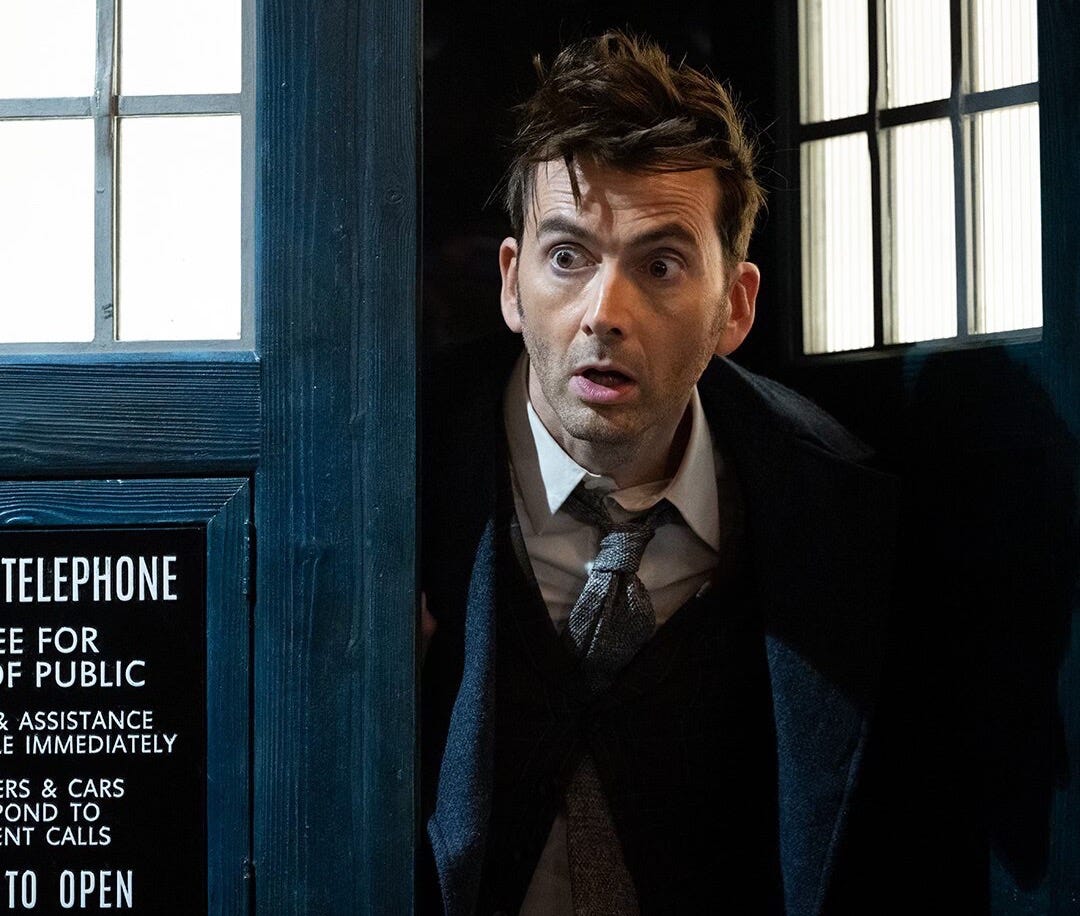
In 1966, the British sci-fi series Doctor Who was three years old. But when its lead actor, William Hartnell, decided to retire from playing the titular Doctor, the show’s producers had to come up with a way for the series to continue.
So they introduced the concept of regeneration; the character of the Doctor was given the ability to change every cell in his body, effectively changing his appearance while remaining, fundamentally, the same person. And of course, it gave Doctor Who the key to its longevity; every time an actor decided they wanted to quit the role, a producer or show runner could simply cast a new actor to take his place.
The concept of regeneration has allowed the series itself to regenerate and adapt to the changing world around it, all the while remaining true to its original concept: an eccentric alien travels time and space in a blue police box. Doctor Who is now sixty-two years old, and the show has been on air for forty-six of those years. In that time, nearly twenty different actors have played a version of the role (and yes, Doctor Who fans, I’m counting Peter Cushing)
Since it returned to television in 2005, the modern incarnation of Doctor Who has been appointment television, often drawing in weekly audiences of over 10 million viewers.
But something happened in 2025. For the first time, the show has felt unwatchable. Its ratings have steadily gotten worse. The latest actor to play the part, Ncuti Gatwa, has left after only two series. And Disney, having co-produced the most recent series with the BBC, has ended its creative collaboration with the Corporation.
The BBC has assured us that the series will return. But does it deserve to? For reasons that I’ll get into in this post, something about Doctor Who now feels tired and outdated in a time when other high-concept sci-fi shows with bigger budgets are competing for our attention.
History repeats itself
Doctor Who has been here before. In the 1980s, the classic version of the series had been on air for over twenty years. But many of the things that might have endeared it to the viewing public in the 1960s and 1970s were now starting to make it feel dated.
The wobbly cardboard sets were starting to look silly, especially in a decade where Hollywood was pumping out high-concept science fiction like The Empire Strikes Back, E.T. and Back to the Future. The acting was increasingly dreadful; Doctor Who of that era often felt like it was held together by the goodwill and high camp of actors who were taking a few months off from the Royal Shakespeare Company, happy to indulge in a bit of light ham.
Yes, it was really this bad
In 1986, a BBC television producer called Michael Grade, who felt that Doctor Who had long passed its prime, took it off the air for an extended period of time. It received a reprieve between 1987 and 1989, during the underrated era of Sylvester McCoy. But finally, in 1989, the writing was on the wall and Doctor Who was cancelled.
(Incidentally, I was a part of that strange generation of British children who grew up without a version of Doctor Who on television. I was three when it was taken off air and eighteen when it finally returned.)
The man now famous for bringing Doctor Who back to television in its modern incarnation was Russell T. Davies (hitherto referred to as RTD). RTD’s new Who was envisioned as a sci-fi series with much more 21st-century production values.
Gone were the cardboard sets and laughable aliens; new Who made use of more modern CGI. Davies strengthened the role of the Doctor’s companion, making the series more centred on their life and their background. The writing was sharper and funnier, with more long-running story arcs and ongoing mysteries.
RTD also shed Doctor Who of some of its weightier mythology, killing off the Time Lords, the ancient race of which the Doctor was a member. This also had a secondary effect of making the Doctor himself more of a three-dimensional, enigmatic character.
The actors who would play the character also breathed fresh life into the show. Christopher Eccleston and David Tennant made the Doctor more relatable - less stuffy professor and more intergalactic action hero.
Davies’s template was built upon by Steven Moffatt, the longest-serving producer and head writer of the modern series to date. Moffatt took more risks with the world of the show, mining the concept of time travel to create some truly thrilling science fiction.
In theory, the current era of Doctor Who should be a ratings-winner. Russell T. Davies announced his return as showrunner in 2021 to great fanfare. He debuted a trilogy of new stories to mark Doctor Who’s 60th anniversary in 2023, with David Tennant also briefly returning to the role.
So what went wrong? Why does this timeless (pun intended) sci-fi series once again feel like it’s had its day?
Moffatt’s ‘Weeping Angels’ speech | Blink
A crowded market
The most obvious reason for Doctor Who’s decline in popularity is that it’s suddenly competing with a lot more content. When Davies first resurrected it in 2005, Doctor Who was still a product of a world of linear television. Streaming and on-demand television were still relatively embryonic
Twenty years later and Doctor Who exists in a more fragmented media landscape. The big streaming providers are releasing more high-concept science fiction and fantasy than we have time to watch. Doctor Who sits alongside other long-running franchises such as the Marvel Cinematic Universe and the Star Wars and Star Trek spin-offs being pumped out by Disney+ and Paramount Plus respectively.
What’s more, these franchises often have bigger budgets and attract bigger Hollywood talent. Suddenly, Doctor Who finds itself back where it was in the 1980s, appearing dated and lower-budget when compared to its other sci-fi stablemates.
Tedious storylines
I mentioned earlier that part of Davies’s original genius was shedding Doctor Who of its weightier mythology. But after another two decades, six incarnations and three show runners, the series once again feels bogged down by tedious storylines and narrative cul-de-sacs.
In 2018, Moffatt was succeeded by Chris Chibnall, who also introduced the first female Doctor. But what should have been a groundbreaking era of Doctor Who was ruined by mediocre scripts and a storyline that essentially rewrote the entire backstory of the character.
Chibnall came up with a half-baked storyline wherein it was revealed that the Doctor was in fact not a Time Lord, but was instead an orphan from another, as yet unidentified alien race (to the non-fans reading who have read this far, I’m sorry, I feel bored even typing this).
The return of RTD in 2023 has somehow made the problems worse. Again, RTD’s second era was technically a milestone for the series; following on from its first female Doctor, Ncuti Gatwa was the show’s first black Doctor.
But RTD appears to have lost the magic touch he possessed during his first tenure. RTD Mark 1 knew how and when to give audiences the crowd-pleasing aliens that make Doctor Who so iconic: the Daleks, the Cybermen, and The Master.
To play devil’s advocate for a moment, I suppose you can’t keep bringing those aliens back ad infinitum. But RTD has instead used his second tenure to mine the depths of Doctor Who lore for more obscure villains that you’ve only probably heard of if you’re a super-fan; villains like Sutekh, the God of Death (yes the Doctor fights ancient Egyptian gods too, DO keep up) and the Rani, another Time Lord nemesis of the Doctor (nope, me neither).
Preachy scripts
At risk of temporarily turning this Substack into a Daily Telegraph opinion column, Doctor Who of recent years has also developed more of a tendency to preach to its audience. Dare I say it’s woke?
The nature of Doctor Who means it’s always had a didactic streak. The character of the Doctor is a pacifist among warriors, a traveller who exists to right wrongs and correct injustices. It’s easy to forget that it’s fundamentally a family television series, with positive messages for children built into the DNA of most stories.
But the Chibnall and RTD 2 eras have taken this to ridiculous new extremes. Apart from a few exceptions, most episodes have lost the moral ambiguity that made modern Doctor Who such compelling viewing when it first returned. Most of the Doctor’s companions now exist to remind him/her how wonderful he is (a narrative device that was beautifully parodied in a recent episode of Dead Ringers)
Often, viewers are beaten over the head with the moral of the story. Who can forget the social studies class that is ‘Rosa’, the Jodie Whittaker episode where the Doctor has to save civil rights campaigner Rosa Parks from an Evil Space Racist From The Future?
The preachy scripts mean that the plot takes a back seat. The journalist and Doctor Who fan Jonn Elledge wrote a good summation of why an episode wherein the Doctor’s sole job is to ensure Rosa Parks takes her seat on a bus(!) is worthy, but fundamentally lacking in drama.
The single biggest thing on that list is that it’s fundamentally undramatic for the Doctor’s goal here to be to change nothing and not fight racism. Obviously the show can’t imply that a fictional white alien with a British accent inspired the civil rights movement, that would be awful. But there must be a middle ground – have the Doctor do something else while the civil rights struggle is going on in the background maybe?
Don’t get me wrong, it’s good to teach children who might be watching Doctor Who about a pivotal moment in the civil rights movement. But contrast an episode like ‘Rosa’ with ‘Vincent and the Doctor’, a beautiful episode wherein the Doctor tries to help Vincent van Gogh cope with his depression.
At its peak, even the historical figures in Doctor Who felt like fully three-dimensional, flesh-and-blood characters with motivations that were key to the plot, not ciphers who existed to prove a point: Charles Dickens is portrayed as a man grappling with his own mortality; the Doctor encounters Shakespeare when the Bard is grieving the death of his son.
But too many episodes of Doctor Who now ram the inherent virtuousness of the characters down my throat. It’s boring.
Possible futures
Where does Doctor Who go next? Much like the 1980s, it could just be the case that a long-running science fiction saga needs another rest.
It’s apparently next scheduled to return in time for Christmas 2026, with RTD having brought former companion Billie Piper back to temporarily take the place of Gatwa (though Piper apparently isn’t playing the Doctor - confused yet?).
It’s unclear how long RTD will stay on. As much as I admire his writing, I’m increasingly of the belief that it’s time he gives way to a new show-runner if Doctor Who is going to survive.
In order to stay relevant and interesting, it needs to simplify the story, get back to compelling plots and moments of genuine drama. It needs to give the Doctor an interesting, coherent, dramatic arc and make his companions more three-dimensional, not sidekicks whose sole goal is to dispense platitudes.
Doctor Who’s capacity for regeneration has always been the most remarkable thing about the series. But under its current creative leadership, it feels stuck with the same old face.